Rug sizes, by bed size
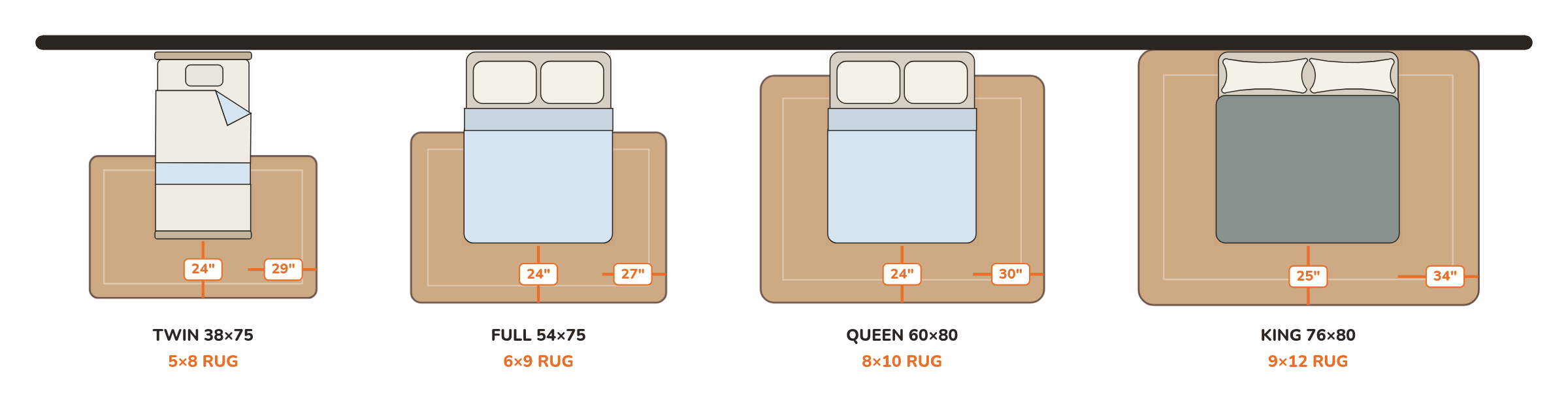
Twin, full, queen, king, each one has a rug that fits, and the test is the same every time: enough rug showing on three sides that your feet land on it when you get out of bed.
Bedroom rug sizing, 24 inches showing on three sides
Work out the right rug for a bed, then check it against the room
Cold floor, first thing in the morning. That's what a bedroom rug is for, not decoration, not softness in the abstract. The place your feet land.
Which gives you the test, and it's a good one:
When you swing your legs out of bed, do your feet land on rug?
If they land on cold floor, the rug is too small or in the wrong place, no matter how nice it looks from the doorway.
The rug sticks out on three sides
Same shape as the dining rug, different room. Under a bed, the rule is:
The rug should show at least 24 inches past the bed on both sides and at the foot.
Three sides, the same three sides that need clearance. That is not a coincidence: the rug is covering the walking space, because the walking space is where your feet go.
The head end doesn't matter. It's under the bed, nobody stands there, and half the time it's under a nightstand anyway.
The sizes that actually exist
Rugs come in standard sizes, like doors. So the useful version of this rule isn't arithmetic, it's a short table:
| Bed | Bed size | Rug that fits |
|---|---|---|
| Twin | 38 × 75 | 5 × 8 |
| Full | 54 × 75 | 6 × 9 |
| Queen | 60 × 80 | 8 × 10 |
| King | 76 × 80 | 9 × 12 |
Now check that table against the rule, because something interesting happens.
Take the queen: the bed is 60 by 80, the rug is 8 by 10, 96 by 120. Line the rug up with the head of the bed and you get about 18 inches showing on each side and 40 at the foot.
Eighteen. Not 24. And it isn't just the queen, laid out that way the sides come out short on every row: about 11 inches for a twin, 9 for a full, 16 for a king.
So which way you turn the rug decides whether it passes. Turn it the other way (the long side running across the bed rather than down it) and the sides open right up: 30 inches for that queen, 34 for a king. That is exactly what the picture at the top of this lesson shows, and it is why each rug there is slid down the bed a little, to keep 24 inches at the foot as well. (The king's rug can't slide far enough without going through the wall, so it starts right at the wall and shows 25.)
So the rug you can actually buy will do the job, but only in one orientation, and you have to know which. Go up a size if the room can take it. If you want a true 24 inches on all three sides of a queen whichever way you lay it, you need a 9 × 12, which is bigger than a lot of bedrooms.
Three ways people place them
Not every rug goes fully under the bed:
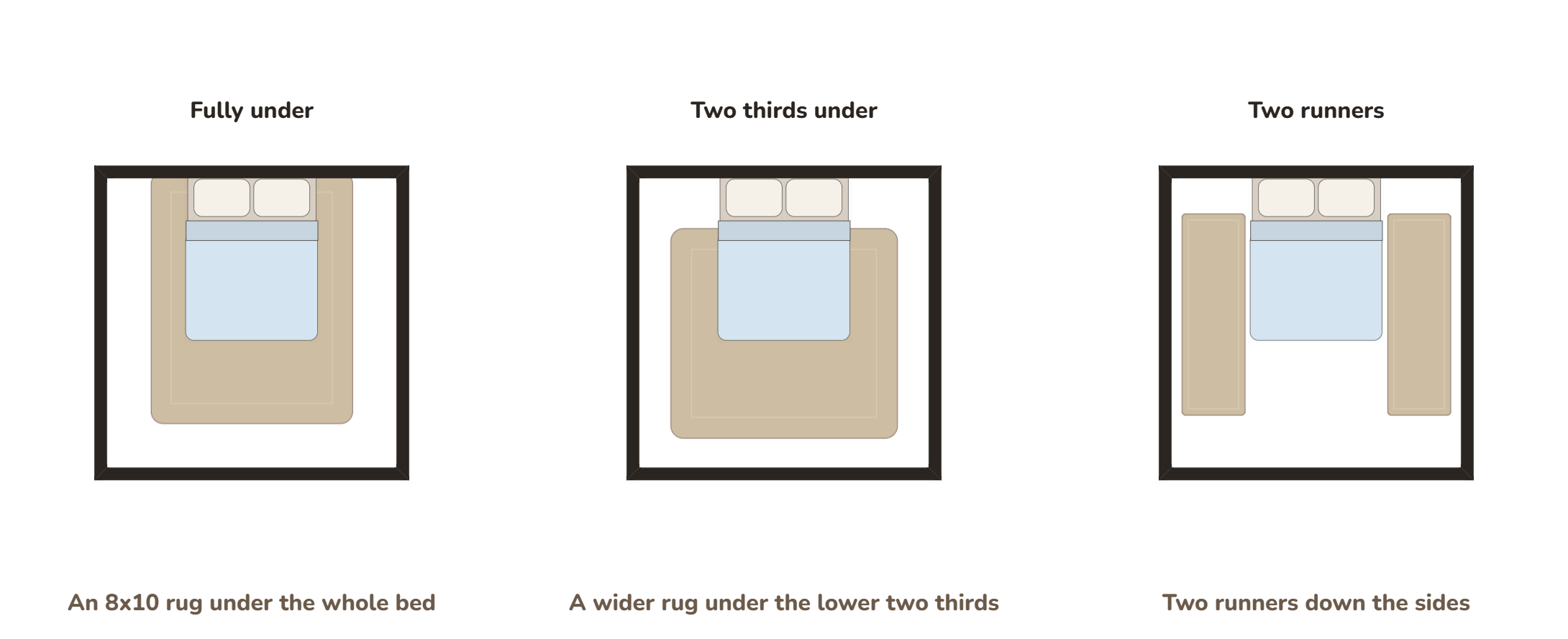
- Fully under, sticking out on three sides. The version above. Best if the room can take it.
- Two thirds under: the rug starts partway down the bed, past the nightstands, and runs out past the foot. Cheaper, because the rug is smaller, and your feet still land on it. Very common and completely legitimate.
- Runners at the sides: two small rugs, one each side, and nothing under the bed. Works, looks deliberate, and is the answer in a room where a big rug simply won't fit.
All three pass the feet test. That's the thing to hold onto: the test is about your feet, not about the rug being big.
Take it into the Designer.
Next, follow along in the Designer, step by step.
Build it → 8 steps in the DesignerDo it in the app
Follow along in the Designer, one step at a time
Open Tiny Architects Designer. This time you get to draw the rug and see whether the number was right.
Room and bedWalls › Outside › House OutlineBedroom › Beds › Queen Bed👆 Show me
11 by 12 feet, with a Queen Bed head to a wall and centered.
Measure the bedMeasure › Custom Measure
Across it and down it. 60 by 80 inches.
Work out the perfect rug before you draw it
Add 24 inches to each side and to the foot:
- Across: 24 + 60 + 24 = 108 inches = 9 feet.
- Down: 80 + 24 = 104 inches, and you'd round up to 12 feet for a standard size.
A 9 × 12. That's the by-the-rule answer for a queen.
Draw itFloors › Rug
Then drag a rectangle starting a foot in from one side wall. Every grid square is one foot, so count as you drag: 9 squares across, 12 down. Let go, and the rug appears under the bed.
Now look at what you just made
The 9 × 12 in an 11 × 12 room leaves less than a foot of floor showing on each side (the walls take a few inches) and nothing at all at the ends. The long way, it runs right into the walls.
Remember the border rule from where a rug stops: a rug should stop about 12 to 18 inches short of the wall. Sideways you're just under the limit. Lengthways you've blown straight through it, and now you can see it rather than picture it.
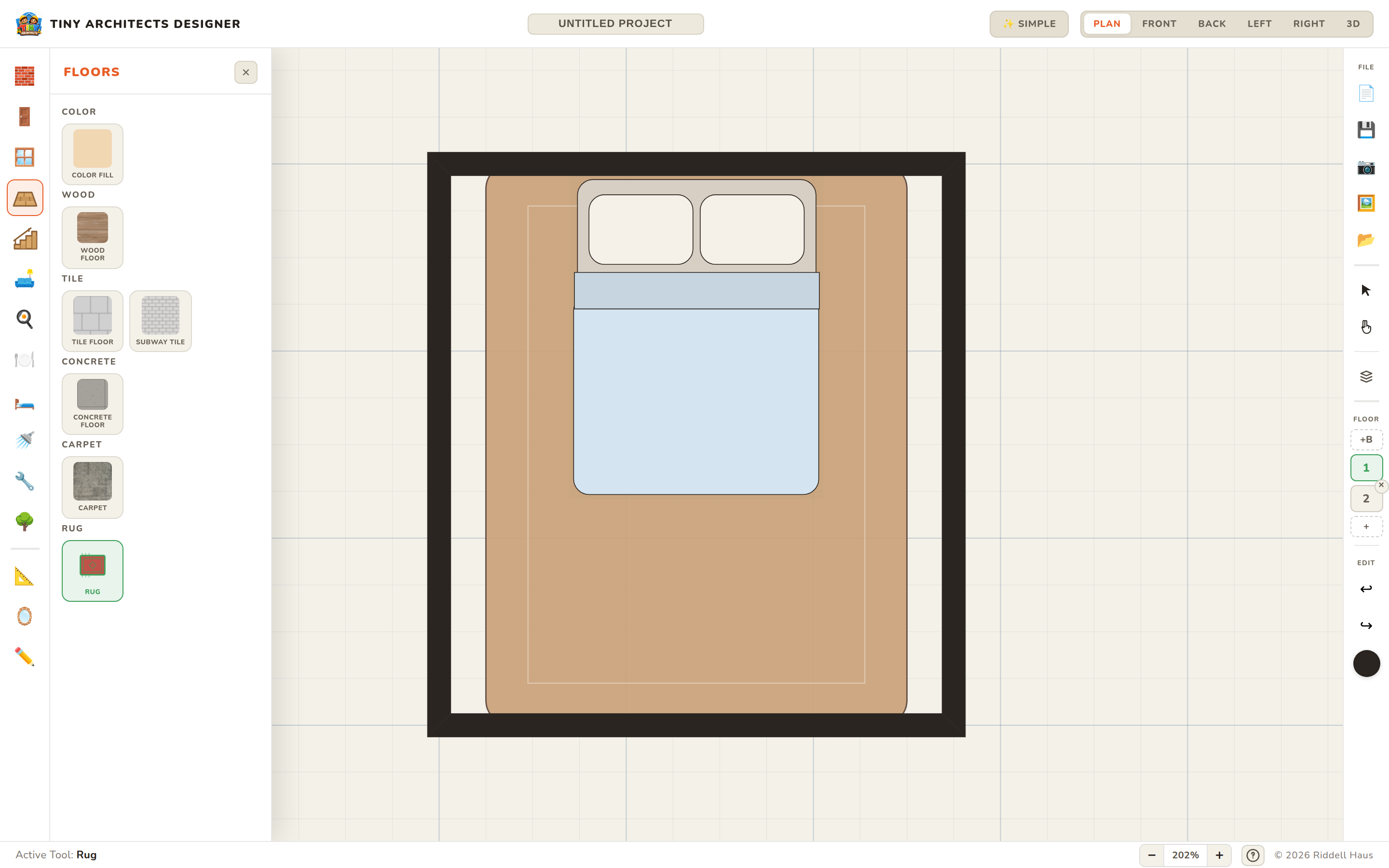
The perfect rug, in a room that can't take it. Delete it and try the 8 × 10
Tap the rug and hit Delete in the little panel, then draw an 8 by 10 instead. This one leaves a border all the way round (a little tight at the ends), and gives about 18 inches beside the bed instead of 24.
Which is the right answer? Genuinely: the 8 × 10. Feet land on rug, the border works, the room reads properly. The 24-inch rule got you into the right neighborhood and then the room made the final call.
Change its shape and color while you're there
Tap the rug again. The panel has Oval and Rect, and a row of colors. An oval rug measures the same way, the rule is about the rectangle it fits inside.
See the alternativeFloors › Carpet
Click inside the room. Wall-to-wall carpet, no rug, no border, no sizing question at all. That's the other way to solve this, and it's one reason a lot of bedrooms have it. Ctrl+Z to put your rug back.
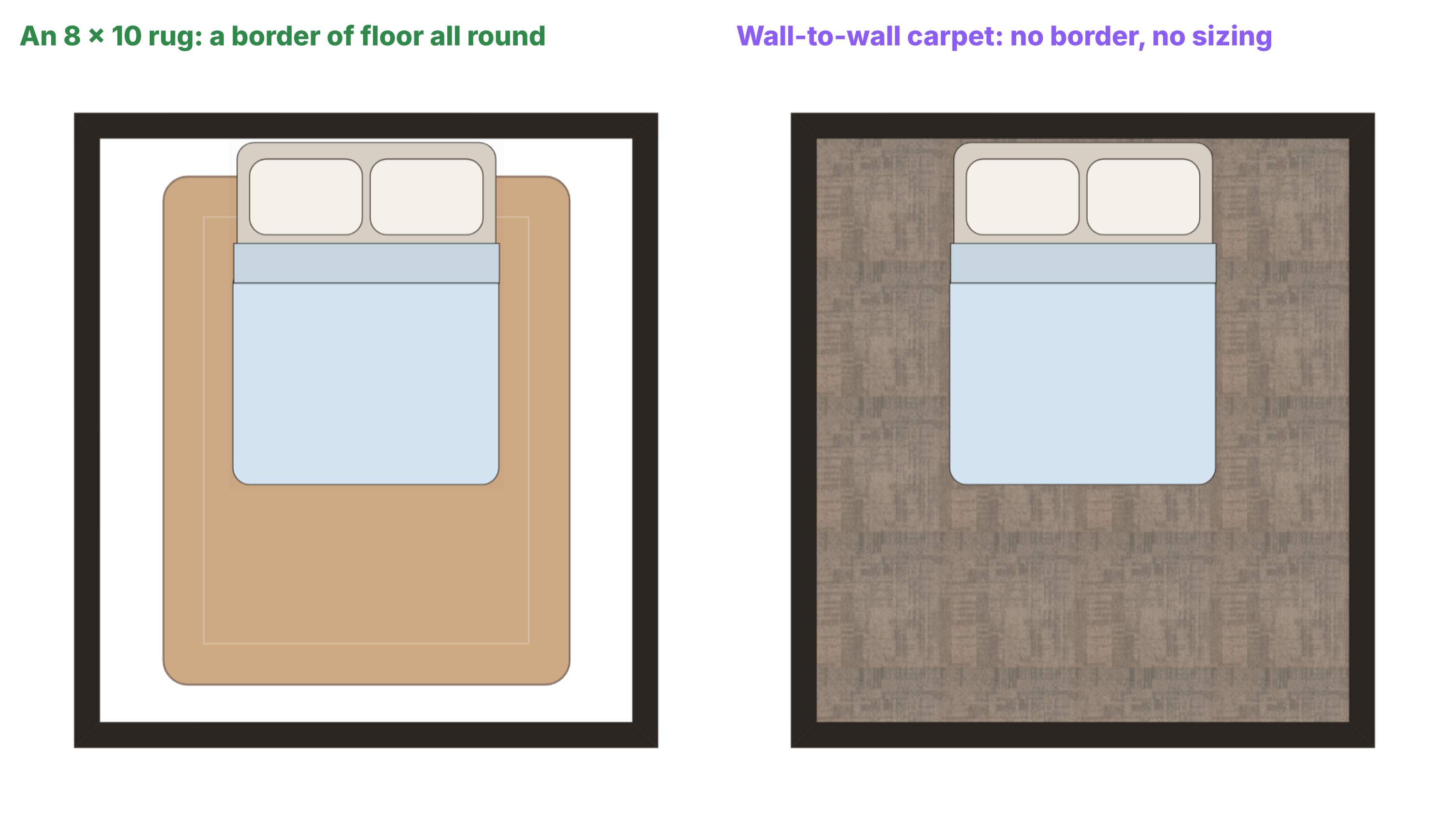
The other way to solve it: no rug at all.
Now make one of your own.
Work out the right rug for a bed, then check it against the room
Your turn →Your turn
Now make your own, using what you just learned
Do the feet test in your own room.
Then work out which rug you should have from the table, and measure whether it would fit the room with a border left over.
If it wouldn't, you've found something real, and the answer is one of the three placements above, not a bigger rug. Write down which one you'd pick and why. That sentence is a design decision, and it's the same sentence a professional would write.