How tall should a nightstand be?
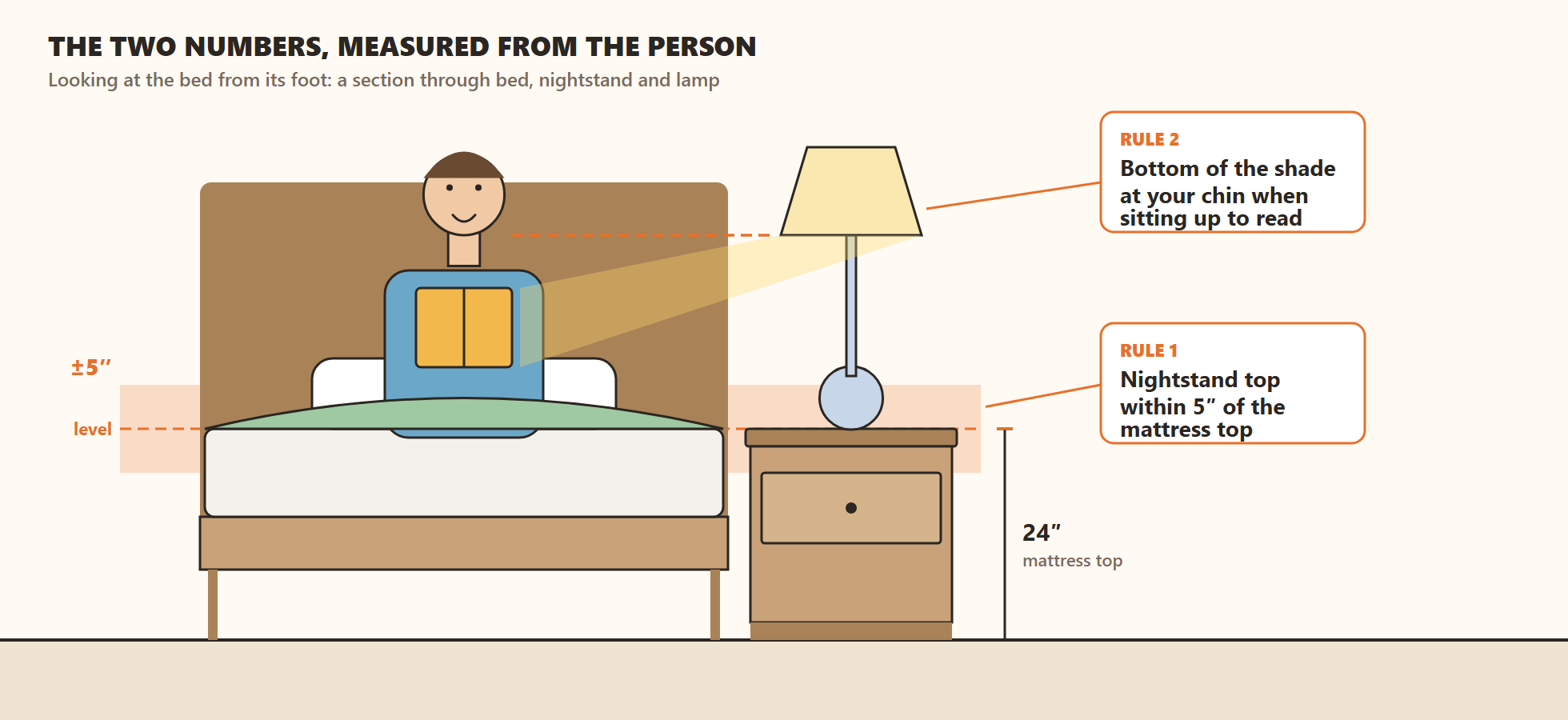
Within about five inches of the top of the mattress, and the lamp shade at chin height when you're sitting up reading. Two numbers, both taken off a person rather than out of a catalog.
Nightstand and lamp height, measured from the person in the bed
Check a nightstand against the bed in 3D, at sitting-up height
Reach for a glass of water in the dark. You know exactly where it is, you don't look, you don't feel around. Your hand goes sideways and slightly down and the glass is there.
Now imagine the nightstand were eight inches lower. Your hand would find air, then keep going, then knock the glass over.
Most furniture in a house is sized from a person doing something. This one is sized from a person lying down, which makes it unusual and easy to get wrong.
Measure from the mattress, not the floor
Furniture heights are normally measured from the floor. A nightstand isn't, or rather, it is, but the number that matters is measured from the top of the mattress.
A good rule of thumb: keep the nightstand within about five inches of the top of the mattress, level with it, or a little above or below.
Level is the ideal. A couple of inches high is fine; you reach slightly up, which your arm does happily. More than about five inches below and the reach turns into a stretch downward, which in the dark means knocking things over.
Why the mattress and not the floor
Because mattresses vary enormously and floors don't.
Two beds in the same room can have tops 8 inches apart, a low platform bed versus a tall frame with a thick mattress and a topper. A nightstand that's perfect beside one is wrong beside the other, and the nightstand didn't change.
So the honest instruction is: measure the top of your mattress, then buy or build to that. It's one reason nightstands come in more heights than you'd expect, and why a mismatched one can feel so wrong.
In the app, a Queen Bed is 24 inches tall and a Nightstand is also 24 inches. Dead level, the textbook answer, which makes the app a good place to see what "right" looks like before you go and measure something real.
The second number: the lamp
There's a companion rule of thumb that's less well known and more satisfying:
The bottom of the lamp shade should be at about chin height when you're sitting up in bed reading.
Think about why. The shade's job is to stop you looking straight at the bulb while letting light onto your book.
- Shade too high: the bulb is at eye level. You get glare, straight in the face, and the page is still dim.
- Shade too low: the light pools on the nightstand and never reaches the page you're holding up in front of you.
- Shade at chin height: the bulb is hidden, the light comes out under the shade, and it lands exactly where the book is.
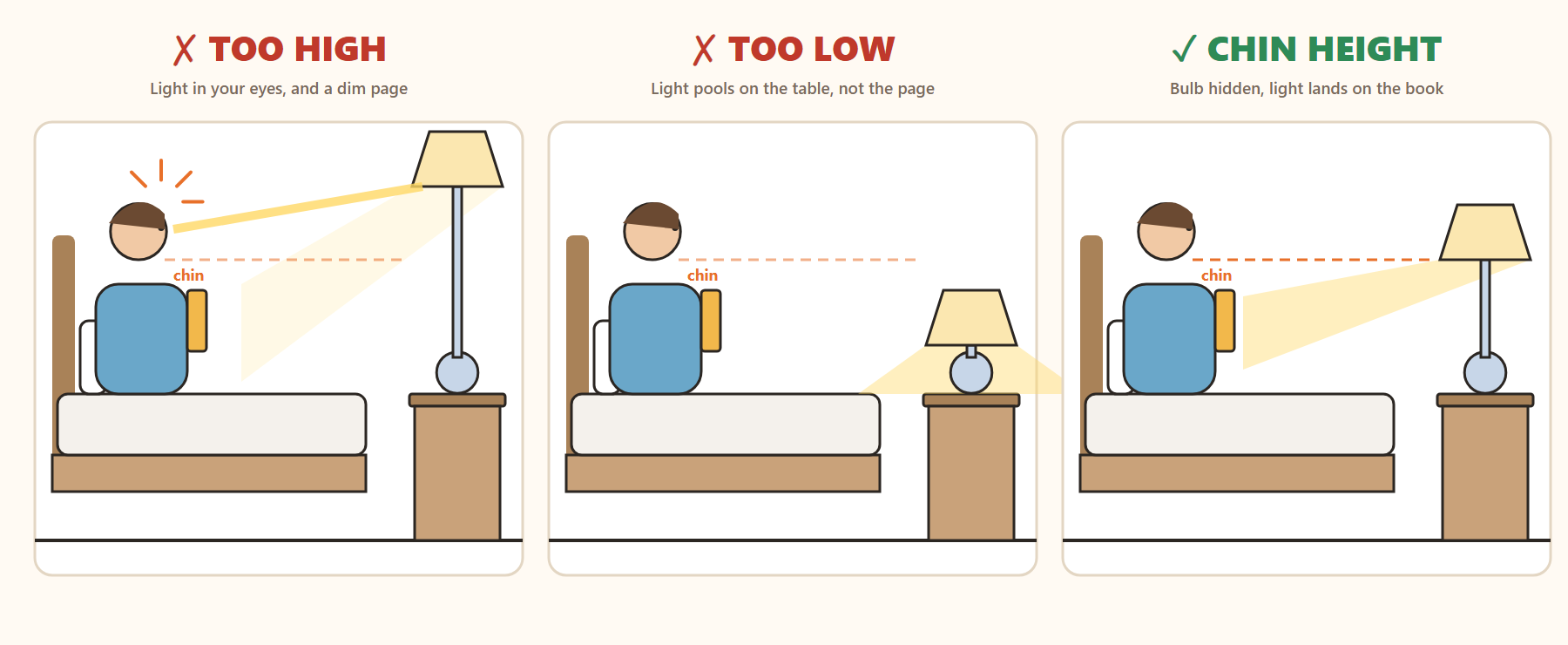
For a lot of adults sitting up in bed that puts the bottom of the shade somewhere in the mid-40s, in inches off the floor. But don't use that number. Use the chin. Sit up in bed, put a hand at your chin, and that's where the shade goes. The rule is written as a body part rather than a measurement precisely because bodies differ, and a nine-year-old's chin is not a grown-up's.
And the width, briefly
A nightstand is often about as wide as it is deep, and it shouldn't be wider than the clearance beside the bed can spare. The app's is 24 inches wide and 20 deep, which is the whole of the 24 inches of clearance the bed asked for.
That's fine, because nobody walks there. A nightstand sits up by the pillows, against the same wall as the head of the bed, and you get in and out of bed further down. What the width has to do is fit: in a tight room, measure the gap between the bed and the wall before you pick one, and choose a narrower nightstand if it's a squeeze.
Take it into the Designer.
Next, follow along in the Designer, step by step.
Build it → 6 steps in the DesignerDo it in the app
Follow along in the Designer, one step at a time
Open Tiny Architects Designer. This is a 3D lesson, the numbers are vertical, so the plan view can't show you the point.
Build a small bedroom with a bedWalls › Outside › House OutlineBedroom › Beds › Queen Bed👆 Show me
11 by 12, with a Queen Bed head to the wall.
Put a nightstand beside itBedroom › Extras › Nightstand👆 Show me
Push it up against the head wall, alongside the bed.
Check the clearance first, in PlanMeasure › Custom Measure
From the far side of the nightstand to the wall. The nightstand is 24 inches wide and it's eating your bed clearance, is there still 24 inches to walk?
If not, that's the trade: a nightstand you can't walk past isn't worth having. Move the bed or use a narrower table.
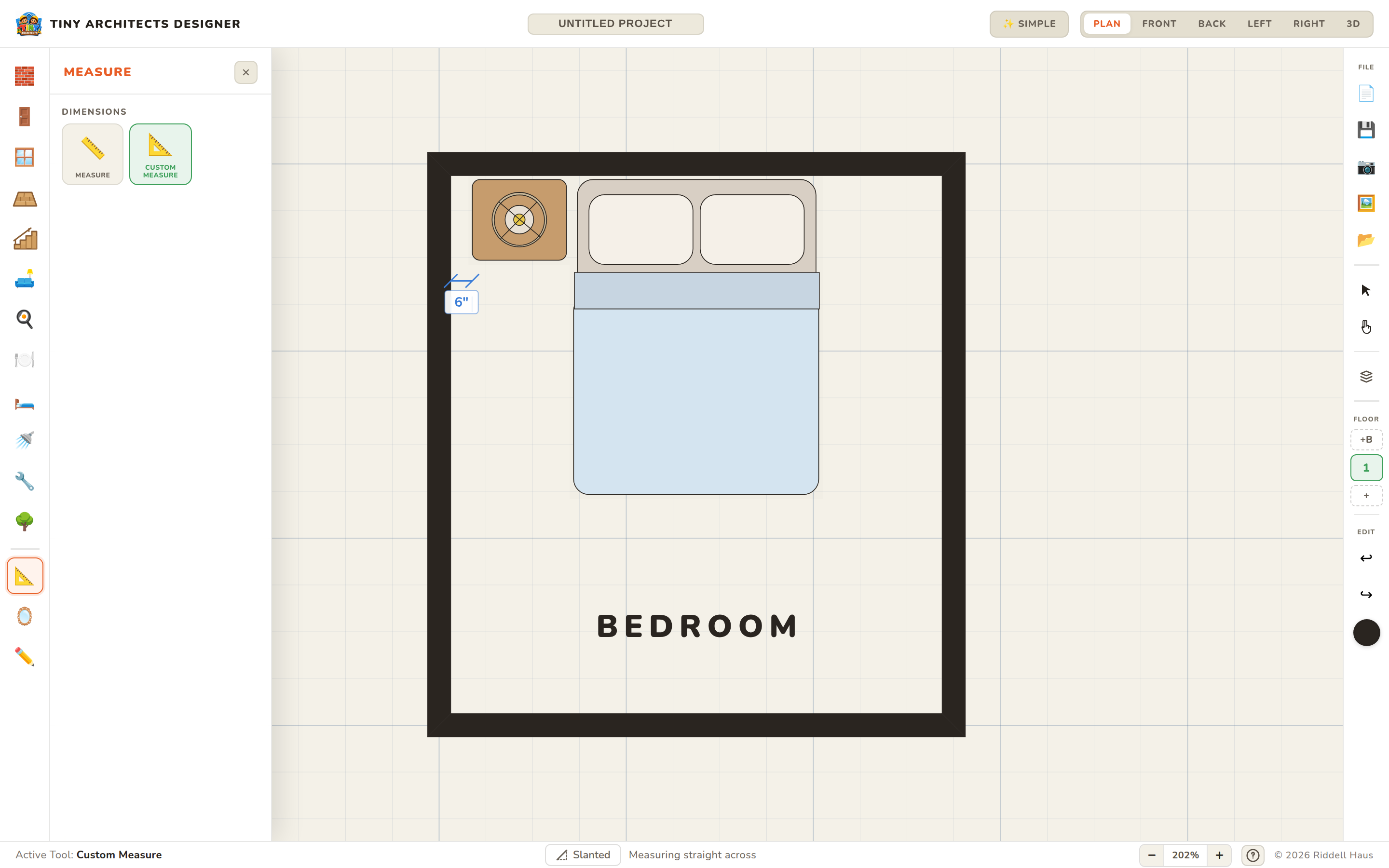
Six inches. Nobody is walking past that nightstand. Now flip to 3D, this is the whole lessonPlan → 3D👆 Show me
Bring the camera down low, beside the bed, roughly at the height of somebody lying in it.
Look along the top of the mattress and the top of the nightstand. They line up. That's the rule, visible.
Break it and look again
There's no height control for furniture in the app, so do this one in your head, or better, do it for real in step 6. Picture the nightstand at half that height, down by your knees. Then picture reaching for a glass in the dark from a horizontal position. That's the failure the rule prevents.
Go and check a real one
This lesson has homework in it, and the app is the reference, not the answer.

The app has no furniture-height control, so this is drawn rather than shot: the eye line runs along both tops, and the dashed red stand is the half-height one from step 5.
Now make one of your own.
Check a nightstand against the bed in 3D, at sitting-up height
Your turn →Your turn
Now make your own, using what you just learned
Measure your own bedside setup.
Then the interesting part. If the lamp is wrong, is it the lamp or the nightstand? A tall lamp on a low table and a short lamp on a high table can land in exactly the same place, so there are two ways to fix it, and one of them is usually free because it's already in the house.
Test it: swap a lamp between two rooms and remeasure. That's a real design experiment with a real result, and it costs nothing.