Draw your own bedroom from memory
Challenge 01. No measuring, no peeking: draw the room you know better than any other room on earth. Then go and find out how wrong you were, because everybody is, and the way you're wrong is the interesting part.
Observation and estimation: how badly memory reports a familiar space
Draw your bedroom from memory, then measure it and draw it again
You have spent more time in your bedroom than in any other room on earth. Thousands of hours. You could walk it in the dark, and you have.
So this should be easy: draw it.
Not from a photo. Not standing in it. From memory, right now, wherever you are. Then go and check.
You will be wrong. Everybody is wrong, including architects, especially architects, who find this exercise unnervingly humbling. And how you're wrong is the whole point.
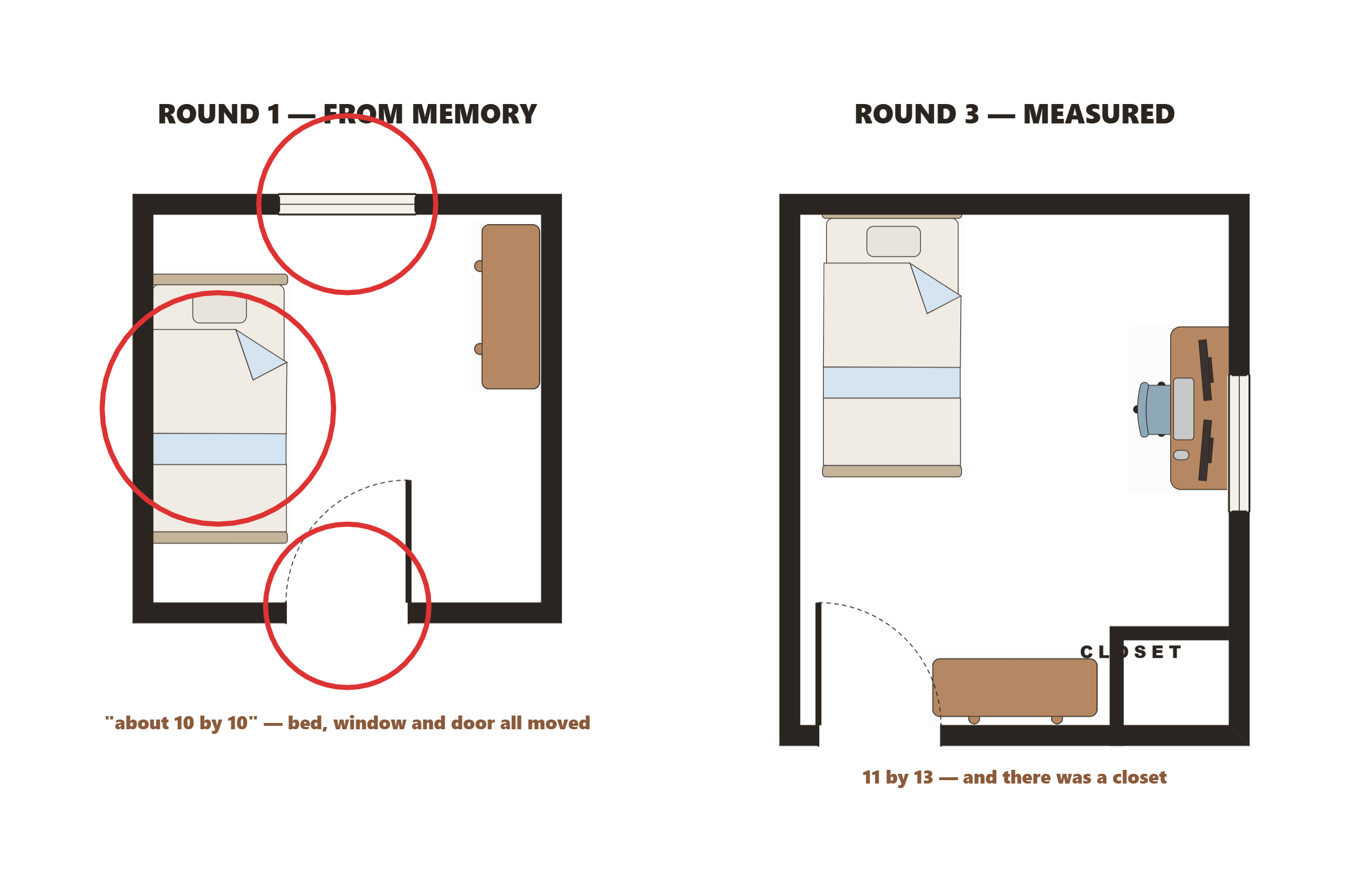
Memory doesn't store rooms, it stores routes
Your brain isn't keeping a floor plan of your bedroom. It's keeping something much more practical: how to get from the door to the bed without stepping on anything.
That's a brilliant system for living in a room and a useless one for drawing it. Which means the mistakes are predictable, so here are five predictions about the drawing you are about to make. Count how many come true:
- Rooms get remembered as more square than they are. Almost every from-memory drawing is closer to a square than the real room. Long thin rooms especially.
- The things you use get bigger. Your bed and your desk take up more of the remembered room than they really do, because you think about them more.
- Windows move. People routinely put a window in the wrong wall. You don't look at your windows, you look through them.
- Doors lose their swing. Almost nobody remembers which way their own bedroom door opens. Go on. Which way does yours open? Are you sure?
- Empty floor vanishes. The parts of the room where nothing happens are the parts memory throws away first, which is why the closet is so often the thing people leave out completely.
Your brain doesn't store a floor plan, it stores a route. So a room drawn from memory comes out squarer than it is, with the furniture too big and the empty floor missing.
None of that means your memory is bad. It means it's efficient. It stored what you use.
Take it into the Designer.
Next, follow along in the Designer, step by step.
Build it → 3 steps in the DesignerDo it in the app
Follow along in the Designer, one step at a time
Open Tiny Architects Designer. Three rounds, and no cheating on round one.
Round one: draw it from memoryWalls › Outside › House Outline👆 Show me
Do not go and look at the room. Do not measure anything. Drag out the shape you think your bedroom is: don't count squares, don't check numbers, just make it look like the room feels.
Then furnish it the same way, all from memory: a Single Door where you think the door is, swinging the way you think it swings; a Single Window in the wall you think they're in; the right size bed where you think it sits; and the big furniture: dresser, desk, whatever's really in there.
Save it, or take a screenshot. This is your evidence. Don't skip that: the whole challenge depends on having the wrong version to compare against.
Round two: go and look
Now walk into the room. Don't measure yet. Just look, with the drawing in your head.
The first thing you notice is usually the shock. Something is in a completely different place than you drew it. Write down three things you got wrong before you fix anything.
Round three: measure it properlyMeasure › Custom Measure
Now the tape measure. Measure the room wall by wall, rounding to the nearest few inches, and redraw it counting grid squares: each square is one foot (that's scale).
Then get the details honest: how far along the wall the door and windows really sit, not just which wall; the real door swing, checked by actually opening it and matched with the two arrow buttons on a selected door (see door swings); and the furniture in its real spots.
Now put the two drawings side by side.
Now make one of your own.
Draw your bedroom from memory, then measure it and draw it again
Your turn →Your turn
Now make your own, using what you just learned
Score yourself, honestly.
Compare your memory drawing with your measured one and count up:
Four or more is good. Seven means you either have an unusual memory or you peeked.
Then the question worth sitting with: the things you got wrong: were they things you use, or things you don't?
Most people find their mistakes cluster around the parts of the room they never interact with. The corner where nothing happens. The wall behind the door. That isn't a flaw in you; it's how attention works, and noticing it is the beginning of looking at buildings on purpose instead of by accident.
Then do it again somewhere harder
Once your own bedroom is done, try one of these from memory:
- Your kitchen. Much harder: more stuff, more edges.
- Your classroom. You've sat in it for a year.
- A grandparent's house. Rooms you knew when you were small usually come out too big, and the reason is wonderfully simple. You measured that room against yourself, and you were shorter then. The room didn't shrink. You grew.
When you've done this one, Challenge 02 is a house with things wrong with it: you find them, then you fix them, which is harder than it sounds.